PLAIN ENGLISH CHALLENGE! This article will be jargon-free and accessible as possible.
“Supermodernism” is a term I stumbled across this week, and after doing some research—most of it involving a dictionary to find out what the hell the authors were on about—I thought the idea was worth exploring.
What is supermodernism, compared to all the other -isms? Modernism sought universal, efficient, scientific truths that overcome superstition and conflict. Postmodernism opposes parts of this, declaring truths to be cultural inventions or the products of oppressive hierarchies. Supermodernism takes all these versions of the truth and simply uses them as needed or consumes them according to personal taste.
So, if Modernism says: “we will create a new universal truth” and Postmodernism says: “there are no universal truths,” then Supermodernism says: “all truths have value, all at the same time.”
To make this easier, I’m going to frame the idea against Grant Snider’s fantastic webcomic “Conflict in Literature,” which I still take out and read before I start writing stories. Please check out his amazing work over at Incidental Comics!

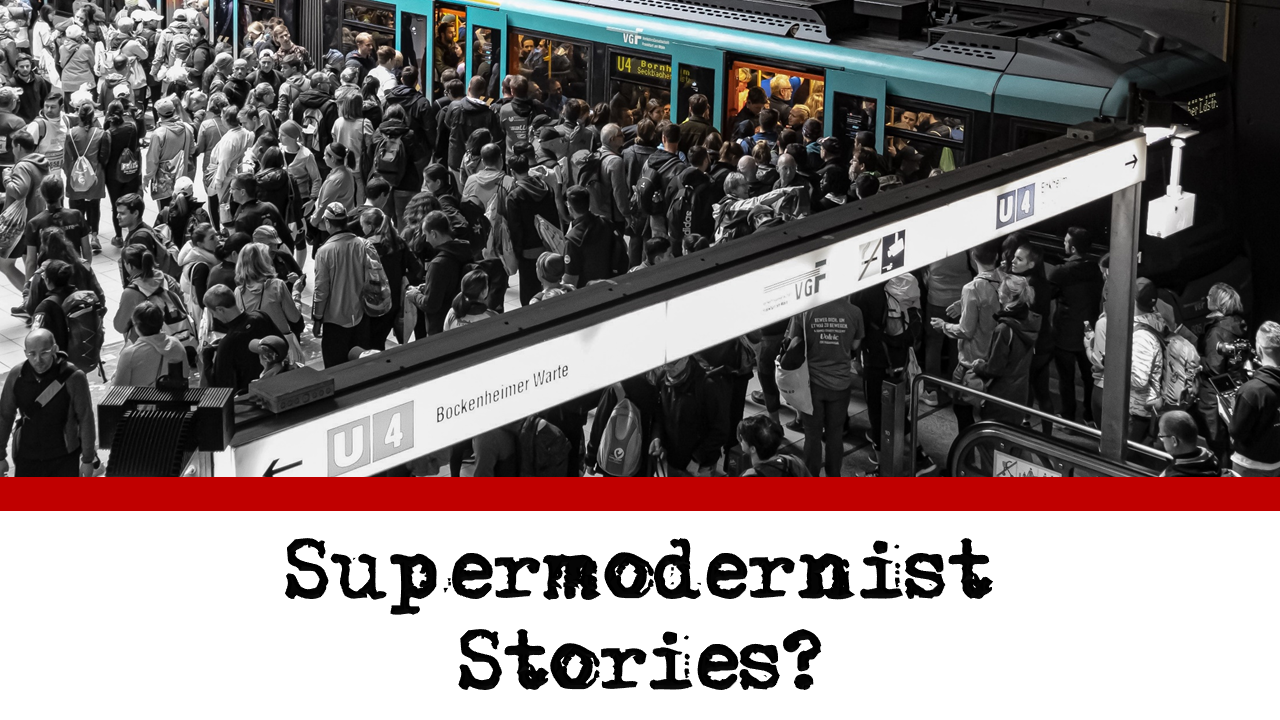
Man vs Space: in a supermodern world, everything – communication, commerce, physical speed – is both hyper fast and performed to excess. Think “non-places,” airports and mega-malls and (more recently) vaccination centers, where individuals gather or pass through with no meaningful interaction with either the place or each other. The hero is a tiny number amongst a crowd of millions, everyone scrambling forward through a race with no purpose, rules, or end point.
Man vs Economy: in a supermodern world, everything is bought and sold. Products, labor, and ideas. Truths no longer have any grounding in history or tradition, only momentary usefulness and interest. Our hero lives in an impersonal global economic machine that they have no input or control over, and, like everyone else, they consume a literal endless stream of information, services, and products. Even poorest members of society create, consume and discard more than all of their ancestors combined – and still live in poverty.
Man vs Identity: in a supermodern world, every person is an endless reflection of identities, each endlessly defended, discarded, adapted and examined. Our hero is probably the most self-aware individual in history, able to tailor their existence to the smallest degree and place their personal stamp on the world – at the same time as everyone else. The end result is that our hero is caught in a world of where everything has meaning and everything is contested. Progressive vs Conservative? Just more grist for the supermodernist mill, baby.
I bounced these ideas off a mind who is older and wiser than mine, and he pointed out that there is similarity here to Dadaism, the art movement that opposed aesthetics, meaning, and, weirdly enough, art itself. His advice to me was that I had missed the most important supermodernist conflict of all: Man vs Supermodernism. No sane person would be able to live in the world I’ve described. Not without going mad. So perhaps supermodernism is a little too grim an explanation for our current world.
Makes for some great stories though.
If you’d like to read a supermodern story, check out R A Lafftery’s “Slow Tuesday Night,” or perhaps listen to “Welcome to the Internet” by Bo Burnham. Outside, of that, please feel free to agree or disagree, and leave a comment below, cheers!
Leave a Reply